Indian cuisine and plant-based eating have more overlap than most people realize, and that overlap runs deeper than a side of dal. For thousands of years, large portions of India have run on lentils, chickpeas, vegetables, and spices, not as a dietary trend but as a culinary foundation. When you are looking for vegan Indian food options, you are stepping into a tradition built around plant-based cooking long before the terminology existed. This guide covers what is naturally vegan, what looks vegan but is not, how to order confidently at any Indian restaurant, and where to get the real thing without guesswork or back-and-forth with the kitchen.
This is the part most vegan dining guides skip entirely, and it matters for understanding why Indian cuisine performs so differently from other options. Plant-based eating in Indian cooking is not a modification or a compromise. It is the original architecture.
Dishes like chana masala, rajma, toor dal, aloo gobi, and pav bhaji were conceived as standalone, fully satisfying meals. The protein load comes from lentils and legumes. The richness comes from slow-cooked spices and tomato masala bases. The satisfaction comes from technique, not from animal products. A properly made chana masala, chickpeas slow-simmered in a spiced tomato-onion gravy, is not a version of something else. It is the dish at full strength.
This distinction matters when you are dining out. At a well-run Indian restaurant or fast-casual kitchen, ordering vegan means ordering dishes exactly as they were designed. You are not asking for accommodations. You are ordering classics.
Dishes that are plant-based by origin, not by modification:
Every vegan diner who has ordered at an Indian restaurant has run into this. Dishes that appear plant-based on the menu contain dairy, either as a cooking fat or as a finishing element. Knowing where dairy hides is the most practical skill you can have.
Ghee is the primary issue. Clarified butter is widely used as a finishing touch on dal, rice, and roti. Most restaurants default to cooking oil because it costs less, but some do not. The question to ask is direct: "Is this made with ghee or cooking oil?" Every Indian restaurant team will understand and answer without hesitation.
Cream appears in many North Indian curry sauces. Palak dishes, korma, and dal makhani all typically contain cream as a finishing ingredient. If a dish is described as rich or creamy, ask whether it can be made with coconut milk. Some kitchens can accommodate this, others cannot.
Naan contains yogurt in the dough and is usually brushed with butter after baking. Standard restaurant naan is not vegan. Roti and plain basmati rice are almost always fully plant-based. Order roti and skip the naan to stay on track.
Paneer is a fresh Indian cheese. Vegetarian, not vegan. Palak paneer, paneer tikka, and matar paneer all contain dairy regardless of how they are described on the menu.
Raita is a yogurt-based condiment. Ask for it on the side so the choice is yours rather than built into the dish automatically.
Most Indian restaurants require a back-and-forth to confirm what is and is not vegan. Curry Up Now operates differently. Vegan options are labeled throughout the full menu, not grouped into a separate section as an afterthought, and they include several of the brand's most popular items.
The burritos menu carries fully plant-based options built on the same tikka masala sauce that made the original food truck famous in 2009. Choose saag or aloo gobi as the filling. Both are classical Indian preparations that are plant-based by default.
The Indian street food section is where the menu most directly reflects Indian culinary tradition. Pav bhaji and samosa chaat are served here. Both dishes were created as plant-based preparations long before any restaurant chain existed, and both are genuinely satisfying as a main course.
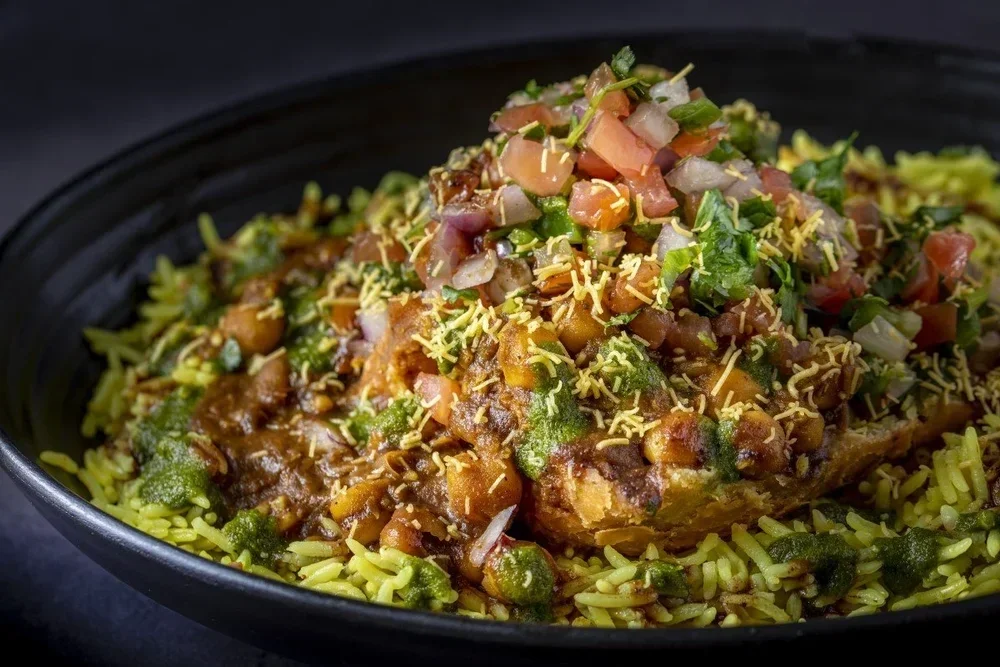
The deconstructed samosa earns a specific mention. Mini samosas on a chana masala base, layered with green chutney, tamarind, crispy noodles, and a yogurt element you can skip on request. It introduces chaat-style eating to people who have never experienced it, in a shareable format that works as a starter or a light meal.
For vegan bowls, Curry Up Now serves two standout plant-based options that go well beyond a standard grain bowl. The Hella Vegan Bowl is built for diners who want a full, protein-forward meal with Indo-Californian flavor. The Peace. Love. Vegan Bowl brings a lighter, cleaner build that balances spice with freshness, making it the right call for anyone who wants plant-based without the heaviness. Both are available over turmeric rice or riced cauliflower, both are clearly labeled, and both deliver the same depth of flavor the brand is known for across its entire menu. The kathi roll with vegetable filling is a lighter, portable alternative that still delivers the full flavor profile. For complete ingredient detail, the allergens page covers everything.
There is no shortage of Indian restaurants in the United States. What is genuinely rare is a brand that has made plant-based dining a deliberate, labeled, and consistent part of its identity rather than something it accommodates on request. That is the distinction Curry Up Now holds, and it matters for three specific reasons.
First, the vegan options here were not added to the menu to follow a trend. The Indo-Californian culinary identity this brand was founded on in 2009 draws directly from a plant-based tradition. Dishes like pav bhaji, chana-based chaats, and aloo preparations are on this menu because they belong here, not because a market analysis suggested it.
Second, the menu labeling removes the friction that makes vegan dining at Indian restaurants unnecessarily complicated. You are not asking three questions before every dish. The information is there, it is accurate, and it is consistent across all locations.
Third, the quality standard does not change based on what protein you choose:
If you are in Flower Mound, Texas, the Flower Mound location at 2717 Cross Timbers Rd, Suite 400 is open daily from 11am to 9pm. Dine-in, pickup, and takeout are available. The store locator covers every location across California, Texas, North Carolina, and Georgia. Check the offers page before you visit and sign up for the rewards program to earn on every order.
Vegan Indian food is not a trend or a niche accommodation. It is the cuisine operating at its core. The dishes with the longest histories, the deepest regional roots, and the most culinary complexity in Indian cooking are the ones built on lentils, chickpeas, vegetables, and spices. When you eat chana masala, dal, or a properly made pav bhaji, you are eating food that has fed people across an entire subcontinent for generations, without modification, without substitution, and without compromise.
The practical outcome for anyone dining out is straightforward. Fast-casual Indian kitchens like Curry Up Now, where vegan options are labeled and the culinary tradition is genuinely respected, give plant-based diners a clear path to a satisfying meal. No guesswork, no settling, and no conversation required about whether the kitchen uses ghee. Dedicated plant-based builds like the Hella Vegan Bowl and Peace. Love. Vegan Bowl exist because the brand made a deliberate choice, not a reluctant accommodation. That is the standard every vegan Indian dining experience should be held to.
Use the store locator to find your nearest location, or order online from Flower Mound today.
FAQs
What Indian food is naturally vegan?
Chana masala, dal, aloo gobi, rajma, baingan bharta, pav bhaji, and potato samosas are all naturally plant-based. No modification required.
Is ghee vegan?
No. Ghee is clarified butter. Always ask your server whether a dish is cooked in ghee or cooking oil before ordering.
Does Curry Up Now have vegan options?
Yes. Vegan dishes are clearly labeled across the full menu, including the Hella Vegan Bowl, Peace. Love. Vegan Bowl, burritos, street snacks, and thali platters.
Is naan vegan at Indian restaurants?
Standard restaurant naan contains yogurt in the dough and butter on top. Order roti instead for a fully plant-based bread option.
Can vegans eat well at most Indian restaurants?
Yes, with a few direct questions about ghee and cream. Lentil dishes, chickpea curries, and dry vegetable preparations are your safest starting points.
What makes Indian food especially good for a vegan diet?
Indian cooking uses legumes, vegetables, and spice-driven flavor as the primary foundation. Plant-based dishes are main menu items, not afterthoughts.
Is the vegan menu at Curry Up Now properly labeled?
Yes. Every vegan item including the Hella Vegan Bowl and Peace. Love. Vegan Bowl is labeled on the full menu and the allergens page provides complete ingredient transparency.
.png)
%20(1)%20(1)%20(1).png)